
Not Every Automation Needs AI, and Not Every AI Needs to Be Agentic
Every second conversation I have with a Malaysian CFO or CIO right now starts the same way. They have just been pitched an autonomous AI agent to run their AP function. Or their AR reconciliation. Or their expense workflow. Or their onboarding process. The pitches sound impressive. The quotes make them wince.
The question I keep getting asked is: "Is this what we actually need?"
The honest answer, most of the time, is no. What most of those workflows actually need is invoice extraction that reads PDFs from suppliers, matches them against POs, and posts the clean ones to the accounting system automatically. Reviewers handle exceptions. A well-scoped pilot ships in eight weeks and pays back inside a financial year, at a fraction of what an "agentic AI system" would cost to build and operate.
But the pitch has "agentic AI" in the title, and boards love that word right now.
This post is about the difference between the automation pattern you need and the automation pattern that sounds impressive. There are usually four to choose from, and only one of them is genuinely agentic.
The four automation patterns
Almost every "automation" pitched to Malaysian enterprises today is really one of these four things:
1. Rules-based automation (traditional RPA)
A script that follows a defined sequence. Log into system A, extract field X, paste into system B, click submit. Great for stable, high-volume, well-defined processes. No AI involved. Zero decisions to make.
2. Classical ML for classification or prediction
Trained models that categorize or predict. Is this transaction fraudulent? Is this email spam? Which customer will churn? Boring, well-understood, cheap to run, and often extremely valuable. Not "AI" in the way most people mean the word today.
3. LLM-based extraction, summarization, or generation
Uses a large language model to do a specific, bounded task. Read this PDF and pull out these fields. Summarize this document. Draft a response. This is what most "AI automation" projects actually are in 2026. Genuinely powerful, genuinely affordable now, and reliable when scoped narrowly.
4. Agentic AI
A system that makes autonomous decisions, calls tools, plans multi-step workflows, and adapts when things go sideways. It does not just extract a field. It decides what to do next.
Only the fourth one is genuinely agentic. The first three are often solving the actual business problem cheaper and more reliably.
What Malaysian finance teams actually need
If you look at what Malaysian finance and operations teams are trying to automate today, the honest breakdown looks something like this:
- ~50% is rules-based work. Invoice keying, timesheet entry, monthly reports, reconciliations against a fixed rule set. Does not need AI. Needs RPA or a straight integration.
- ~30% is LLM extraction or summarization. Reading unstructured PDFs, matching fuzzy data, classifying documents, drafting notifications. AI in the "read and understand" sense. Not autonomous.
- ~15% is classical ML. Fraud scoring, anomaly detection, forecasting. Existing well-understood models.
- ~5% is genuinely agentic. Multi-step workflows with unpredictable branches, autonomous tool use, decisions that would otherwise require an actual analyst.
The industry conversation right now is about the 5%. That is fine for research and hype cycles. It is not fine as a purchase decision for your finance function.
What agentic AI actually costs
I have deep respect for well-designed AI agents. We ship them at BlueAura. But we are honest with clients about what they cost to build and run.
Development cost. An agentic system needs orchestration, guardrails, evaluation, monitoring, prompt versioning, a tool registry, memory management, fallback logic, and human-in-the-loop escalation. A typical agentic MVP costs three to five times a straight LLM extraction pipeline for the same business outcome.
Runtime cost. LLM tokens for agent workflows scale non-linearly. Every planning step is a call. Every tool invocation is a call. Every re-plan on failure is another call. What starts as "RM 200 a month in OpenAI usage" quietly becomes RM 5,000 a month when the agent hits real production traffic and has to re-plan on exceptions.
Operational cost. Agents break in weird ways. They loop. They hallucinate tool calls. They regress after a model provider updates their base model. You need someone competent watching the evaluation dashboards and updating prompts. A production agent is not "set and forget."
Debugging cost. When an agent decides to do something unexpected, tracing why is hard. Every incident becomes a small research project. Your ops team will not thank you.
None of this is a reason to avoid agents. Some workflows genuinely justify all of it. But if a straight LLM extraction plus a rules-based routing layer solves the problem, that is usually the right answer.
The invisible tax of over-engineering
Here is the failure mode I see most often.
A team builds an agentic system because the vendor pitch was agentic. They deploy it. It works for the happy path. Then production traffic hits, edge cases surface, and the agent starts making weird calls. Reviewers stop trusting it. They start reviewing every output. The "autonomous" system now needs 100% human oversight, which means it is slower and more expensive than the manual process it replaced.
Six months later, the CFO asks what the budget actually bought. The honest answer is "a complicated way to do what a simpler system could have done reliably."
The pattern is not unique to AI. It is the same pattern as "we built a microservices architecture" when a modular monolith would have worked. Or "we deployed a data lake" when three well-designed tables would have solved it. Over-engineering has a predictable shape.
A working framework
When we scope AutoGo projects at BlueAura, we run every candidate workflow through four questions.
1. Is this process fundamentally deterministic?
If the same input always maps to the same output through defined steps, this is RPA or a straight integration. AI is unnecessary and adds risk. Ship the deterministic version.
2. Is the hard part reading unstructured data?
Invoice extraction, payment advice matching, contract clause identification, resume parsing. This is LLM extraction territory. Bounded task, measurable accuracy, human-in-the-loop review for low-confidence outputs. Well-solved pattern, ships in weeks.
3. Does the workflow require the system to decide what to do next based on the context it just observed?
Now we are in agentic territory. The system needs to plan, invoke tools, evaluate the result, and adjust. Justify the complexity. What business decision changes if this is agentic versus a decision tree?
4. What is the cost of the system doing the wrong thing?
Rules-based systems fail predictably. LLM extraction fails at the field level and you review it. Agentic systems can fail in ways that surprise everyone. The higher the cost of an unexpected failure, the more the tooling around the agent has to compensate. That often turns a "cheap agent" into an "expensive agent with guardrails."
Most finance and operations workflows are questions 1 or 2. A few are question 3. Genuinely agentic systems earn their complexity when the workflow has real branching decisions and the payoff is worth the overhead.
A worked example
Take AP automation, which we have written about before.
Wrong pattern: An agentic system that receives an email, decides whether the attachment is an invoice, extracts fields, checks against POs, decides whether to post or route, and takes action autonomously.
Right pattern: An email watcher (deterministic) that routes attachments to an LLM extraction pipeline (bounded task) that outputs structured data with confidence scores. A rules layer (deterministic) checks confidence, matches against PO, and either posts or routes to human review.
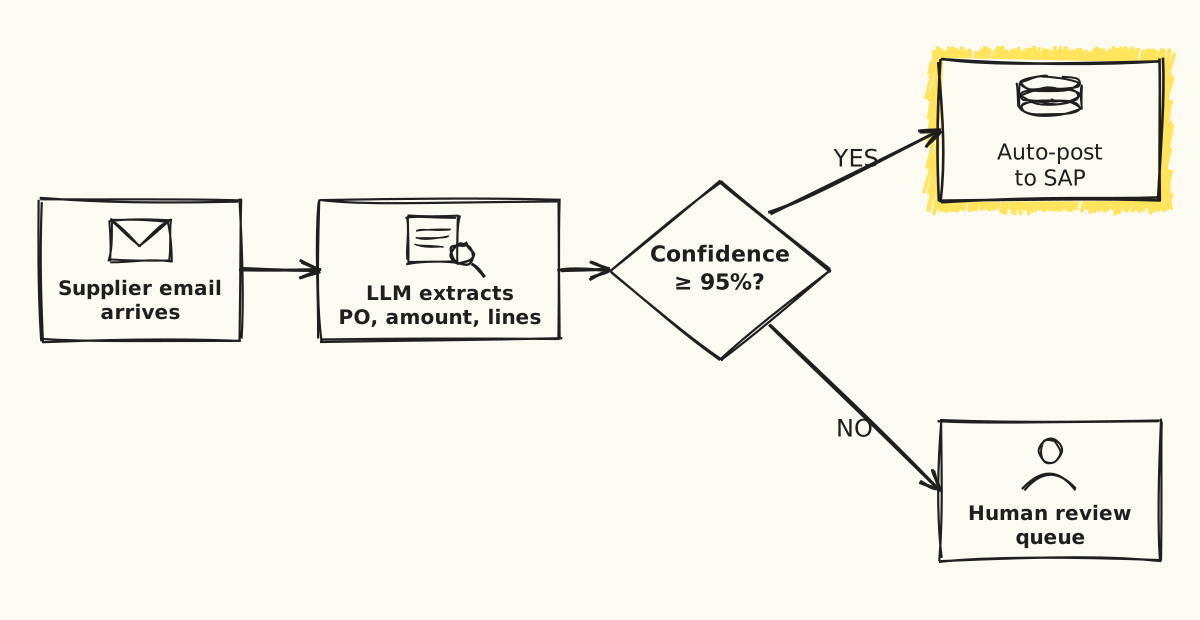
Same outcome. One-third the build cost. One-tenth the runtime cost. Ten times the operational reliability.
Where does agentic actually earn its keep in AP? Not in invoice extraction. Maybe in the exception queue, where a workflow of "look at this weird invoice, check its supplier history, cross-reference the master data, decide whether to auto-post or escalate" might warrant a small, tightly-scoped agent. Small scope. Clear payoff. Justified complexity.
The recommendation
If a Malaysian enterprise asks me today "should we deploy AI agents for X?", my honest answer is:
Start with a rules-based pilot or a straight LLM extraction pilot. Ship it in six to eight weeks. Measure the actual accuracy and coverage. When you know exactly where the pattern breaks down, then decide whether the exception handling justifies an agent.
The people saying agentic AI is the future are right in the long term. The people telling you to buy an agentic AI system to solve your invoice keying problem today are selling you the future at a premium.
Buy the pattern that fits the problem now. Upgrade when the workflow warrants it.
How BlueAura thinks about this
We ship AutoGo with all four patterns available. The AutoGo Agent Builder lets teams design genuinely agentic workflows when the problem justifies it, powered by our Aurix multi-agent engine. But most AutoGo deployments running in Malaysian production today are LLM extraction pipelines with deterministic routing, because that is what most enterprise finance workflows actually need.
That is the honest answer. If you want an agent, we can build you an agent. If you want an invoice keying replacement, we will ship you an invoice keying replacement, and you will pay a fraction of the cost.
Both are legitimate products. Only one of them is what most CFOs need this year.
Related reading:
- Not Everything Should Be Automated — the decision framework for choosing what to automate at all
- Traditional RPA vs AutoGo AI Agents — where classical RPA still wins vs where AI agents earn the complexity
- The Complete Guide to AI Automation for Malaysian Businesses — the broader AI automation landscape
The bottom line
Every automation decision starts with a problem. Match the pattern to the problem, not to the pitch deck.
Rules-based automation still wins for stable, high-volume, deterministic work. LLM extraction wins for reading unstructured documents. Classical ML wins for prediction and classification. Agentic AI wins for genuinely autonomous multi-step decisions.
If your automation pitch has "agentic" in the title but the underlying workflow is deterministic, you are buying a Ferrari to deliver pizza. It will work. It is just not the right tool.
Pick the pattern that fits. Ship it fast. Justify complexity when the workflow earns it.
Get one BlueAura post a week
Practical guides on AI automation, LHDN e-Invoice, and enterprise software for Malaysian businesses. No spam, unsubscribe anytime.
Ready to transform your business?
Let's discuss how BlueAura Technology can help accelerate your digital transformation journey.
Get in touch